Ecuador 2026
Two weeks, something harder every day: mountain biking down Cotopaxi and Chimborazo, enduro on motorcycles and snorkeling on the Galapagos.
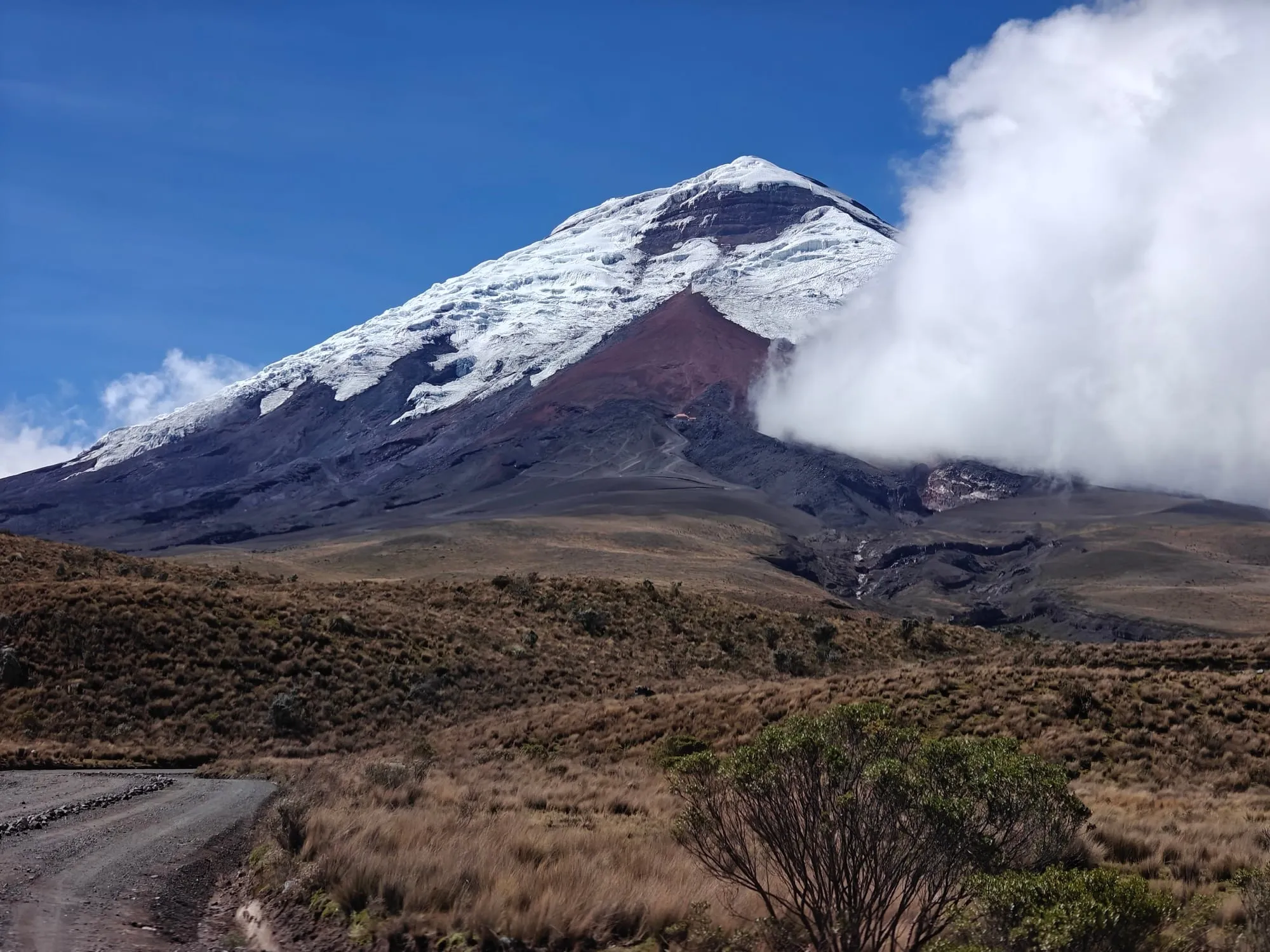
- Highest point
- 4,800 m
- Preparation
- Altitude Tent at home
Amazing Ecuador. Two weeks, from October 16 until the end of the month, and the trip was organized so that every day I did something different, something harder, something outside of my comfort zone.
And that is exactly how it turned out. The whole trip was quite hard for me, exhausting even. But of course, that was the plan, so I am glad it worked out that way.
Cotopaxi
Table of contents
- Best experiences
- Altitude in Ecuador and jet lag
- Part 1: Five days of mountain biking
- Part 2: Three days on motorcycles
- Part 3: The Galapagos
- What a trip
Best experiences
First, the Galapagos. I went snorkeling for the first time in my life. Putting my head underwater was fascinating, all kinds of sounds, and then so many different fish, marine iguanas, sea turtles, sea lions, seahorses, octopus and starfish all around me.
Second, enduro and off-road on a motorcycle. I had never ridden like this anywhere. Back when I had my Africa Twin, I mostly rode on roads and did some very easy gravel. Now it was two days of gravel and sand, and then a last day of hard enduro on a dirt bike, through the mountains and down very narrow descents. Exhausting, and of course excellent.
Third, mountain biking on the volcanoes. We shuttled up by car to 4,600 or 4,800 meters and rode down Cotopaxi and Chimborazo. The surface there is something between scree and sand, and you basically surf it with the bike. Surfing on a bike is a very special feeling.
Altitude in Ecuador and jet lag
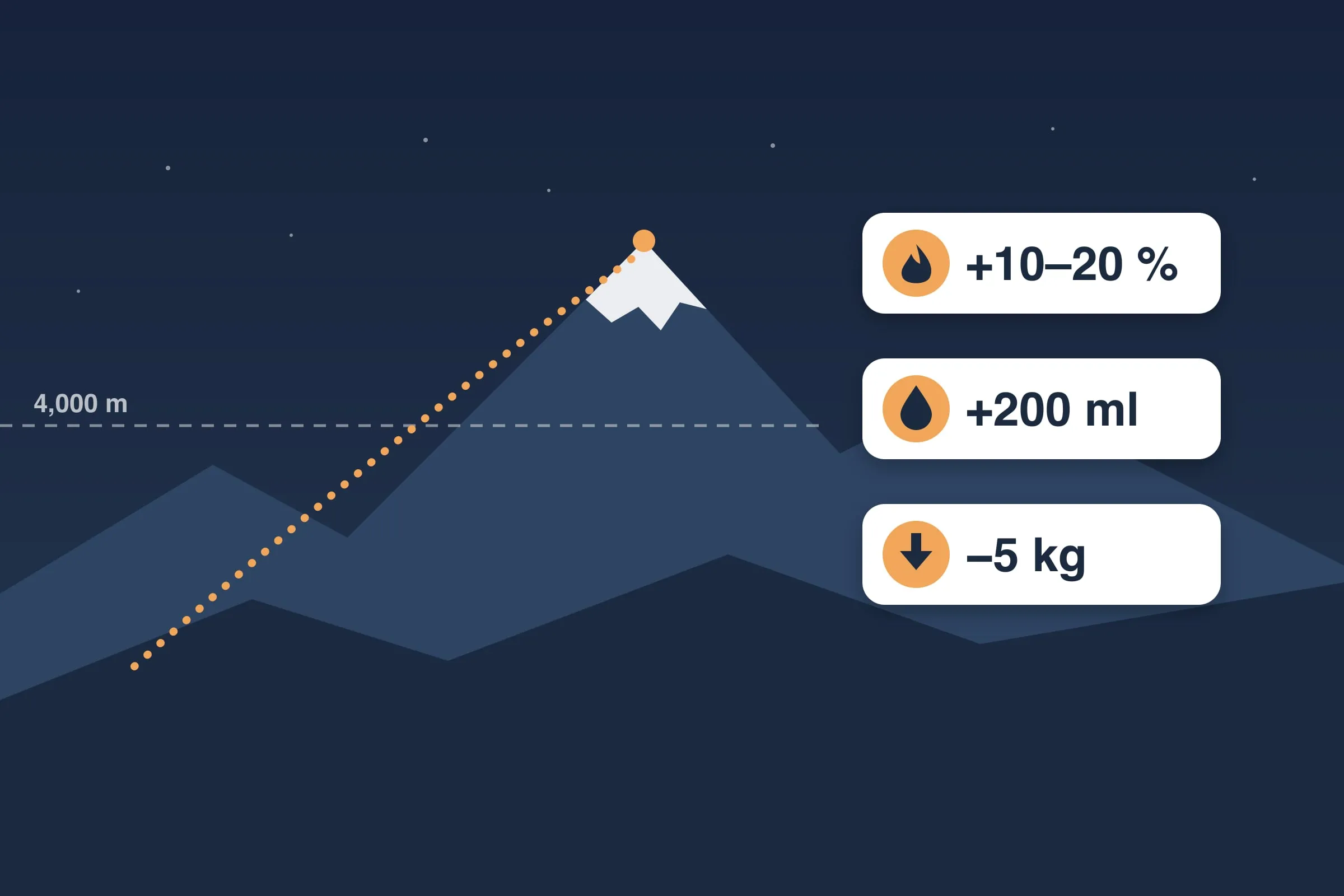
Quito, the capital city of Ecuador, sits at 2,800 meters. Before the trip I had slept in the Altitude Tent, so I was prepared to sleep normally at around 3,000 meters. In the end this helped me a lot. I had no altitude sickness at all, and I felt strong during the trip.
The other goal was to arrive with practically no jet lag, and that worked too. I slept only about four hours on and around the flight, then spent one day completely wrecked. Being that tired made me fall asleep at a normal time, and I was straight into the new time zone.
I kept one day for sightseeing in Quito. I took the TelefériQo, a cable car that pulls you from 2,800 up to 4,000 meters. There is a national park up there where you can walk around, with nice views over all of Quito.
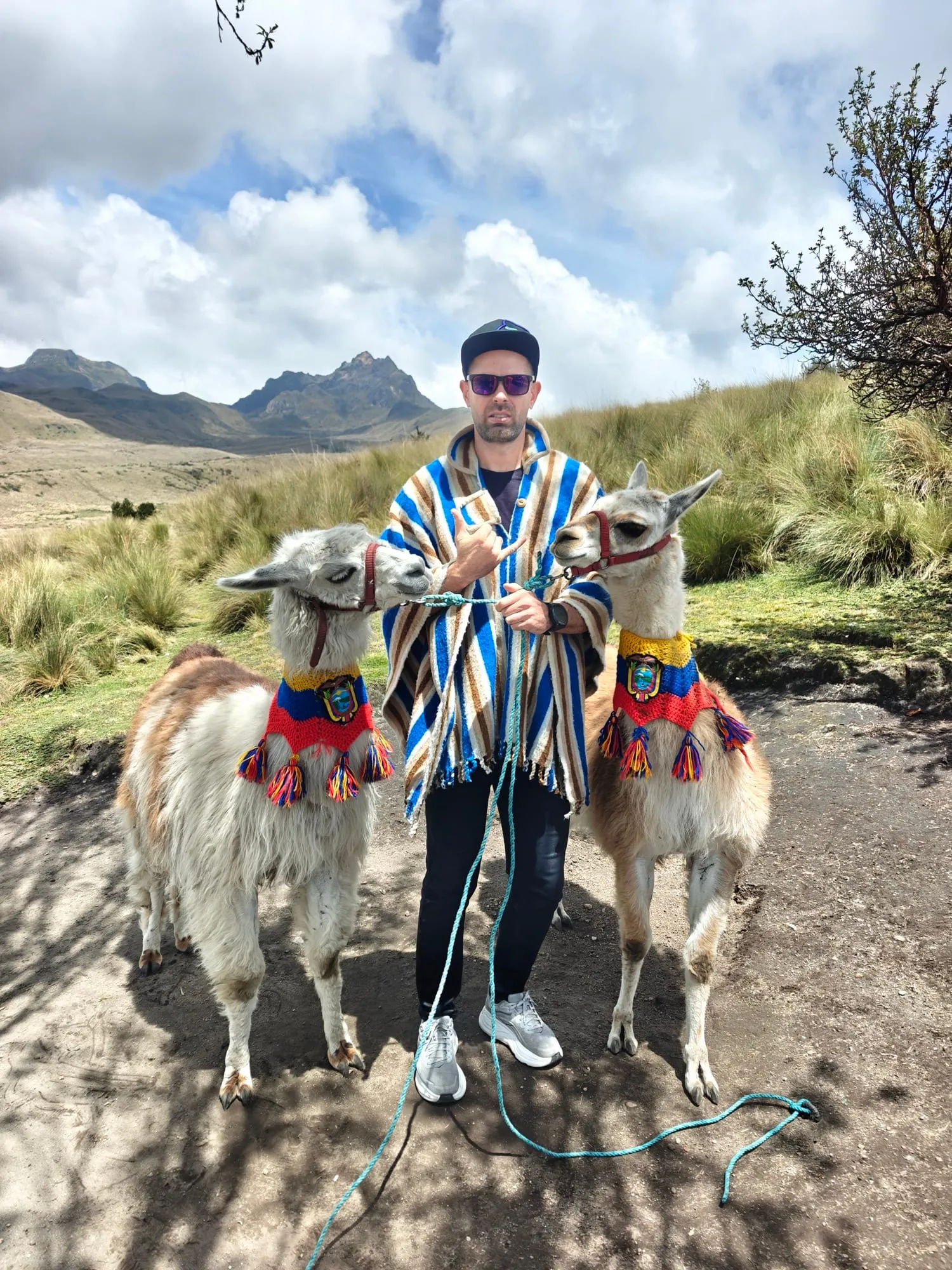
Llamas for 1 dollar
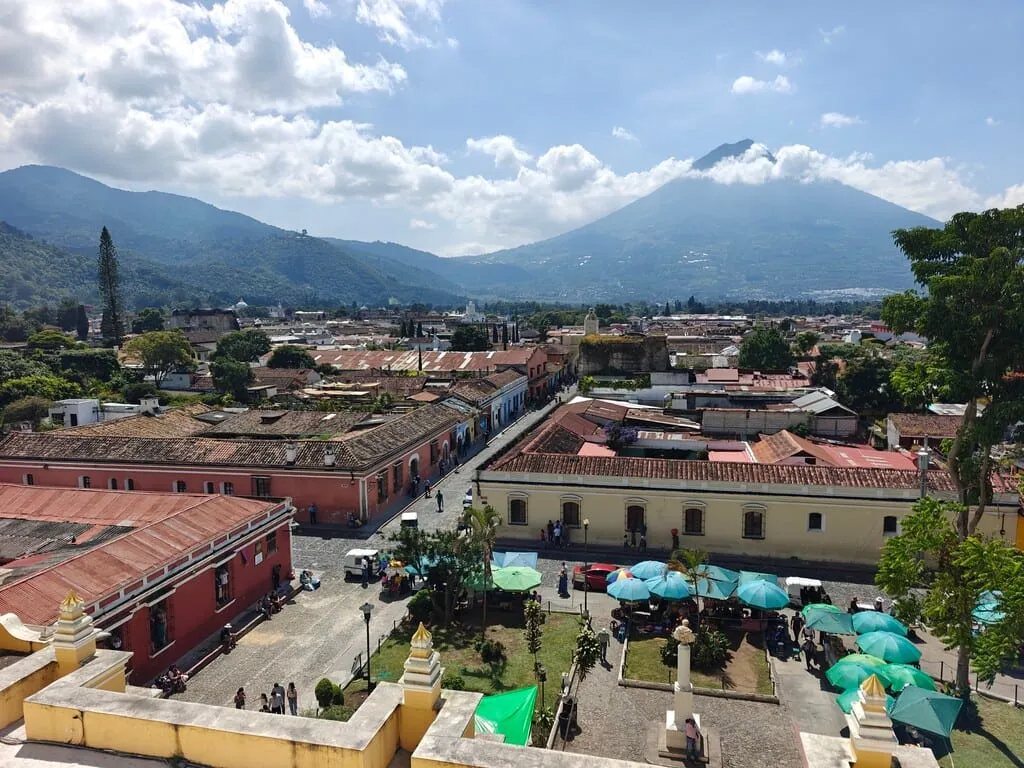
Depending on the “district”, Quito is quite pretty and incredibly green, with big trees and giant mother-in-law’s tongues, or whatever those plants are called. There are good spots in the historic center to see the whole city, but I still prefer the view from the TelefériQo.
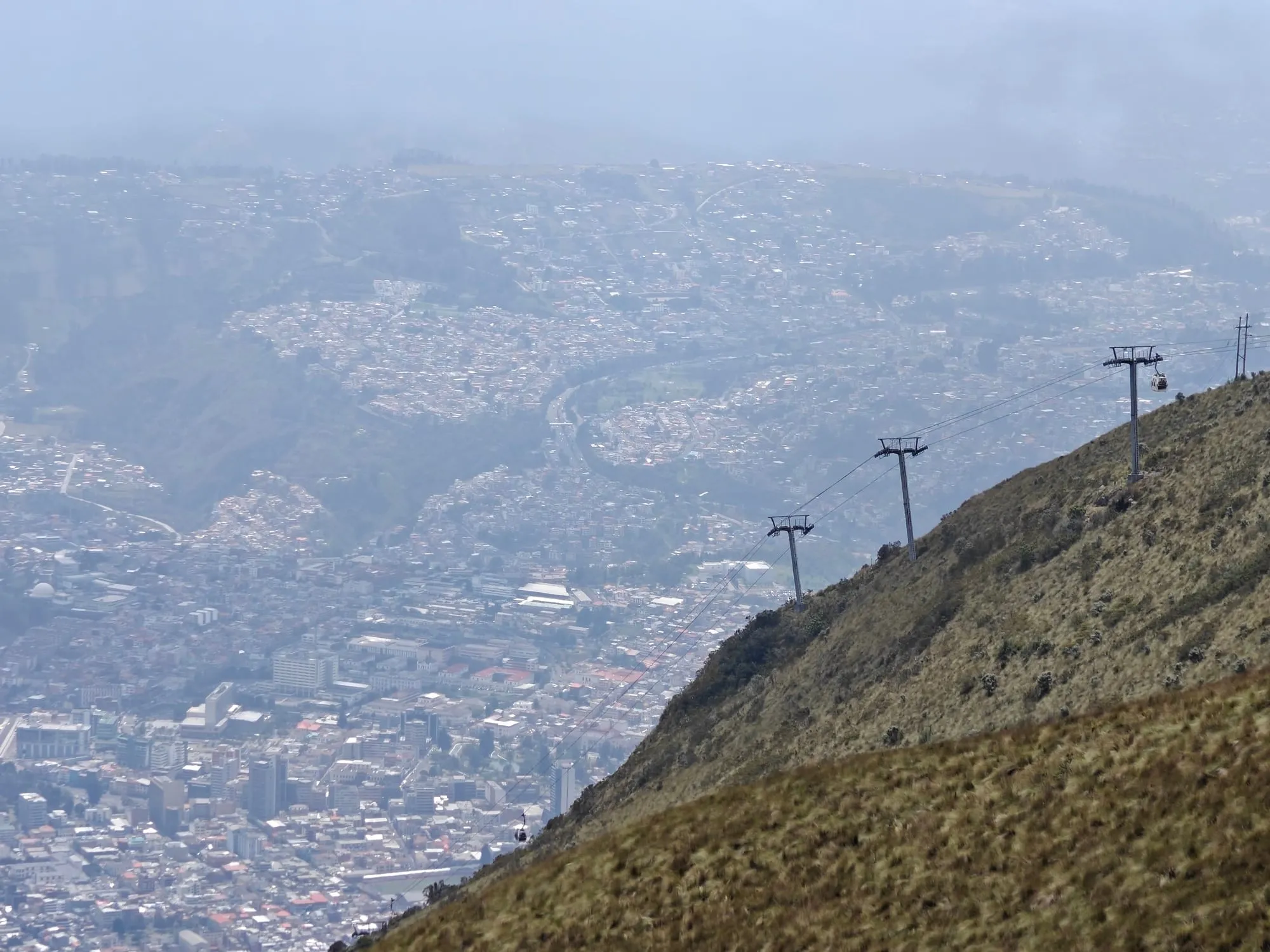
Quito
In the evening I went to a street food festival with some folks I met there. You could have had anything, but chicken with rice seemed like the safe choice, with the days ahead.
Part 1: Five days of mountain biking
The next day the mountain bike part began. I was picked up by Cuervo. I know him through Greg, who has been to Ecuador before. Everybody knows Greg there and respects him a lot. Cuervo prepared a five-day trip tailored to me and to exactly what I wanted to see.
From 4,700 meters down to the center of Quito
On the first day we drove up to 4,600 meters and did some hike & bike. You have the bike on your shoulders and need to climb about 150 vertical meters.
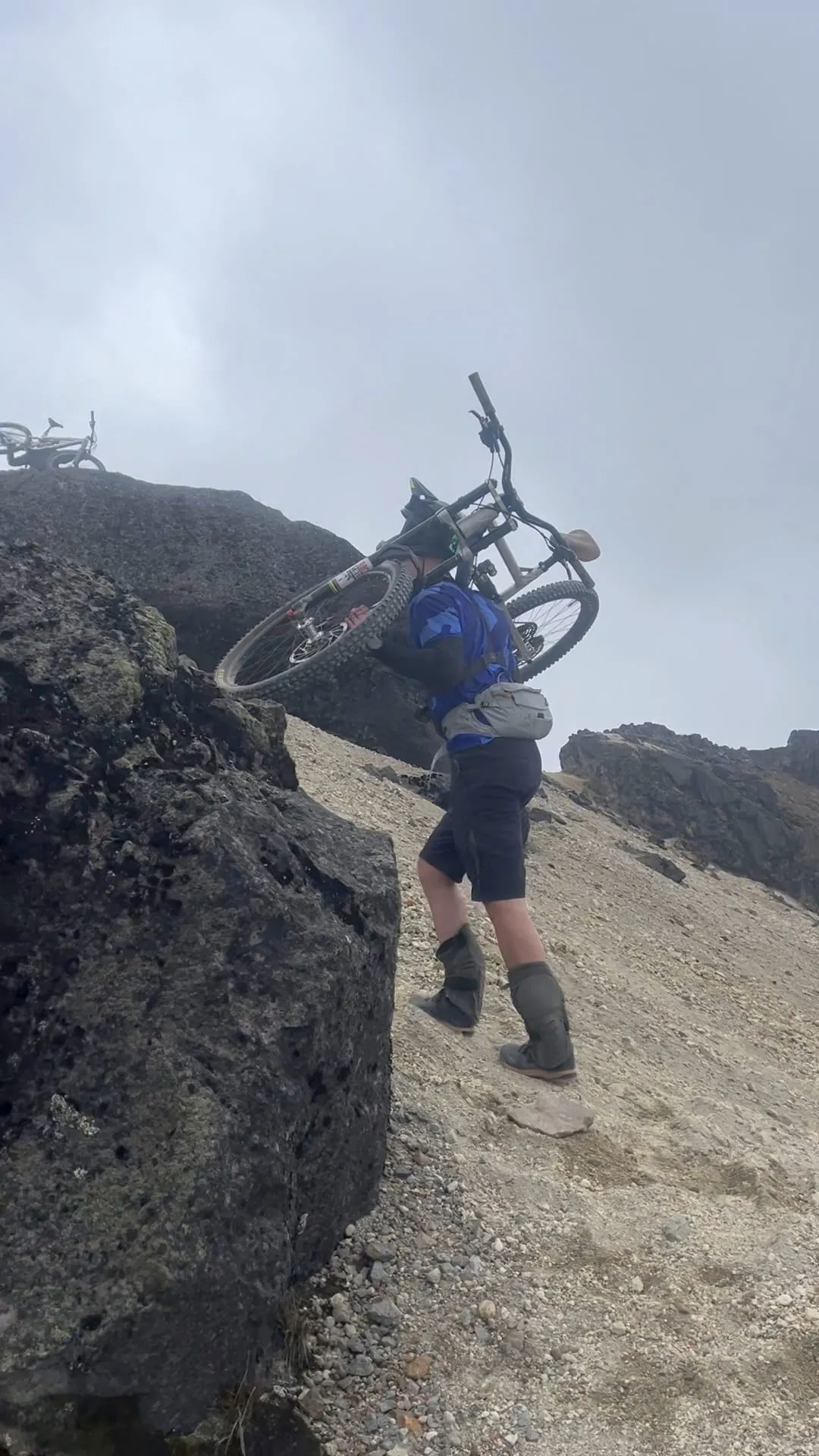
Not much, but at that altitude with a 20 kg bike on your back, it is a bit more demanding. And it was not even my bike. I broke the frame on my own bike a week before Ecuador, so I had to rent one there.
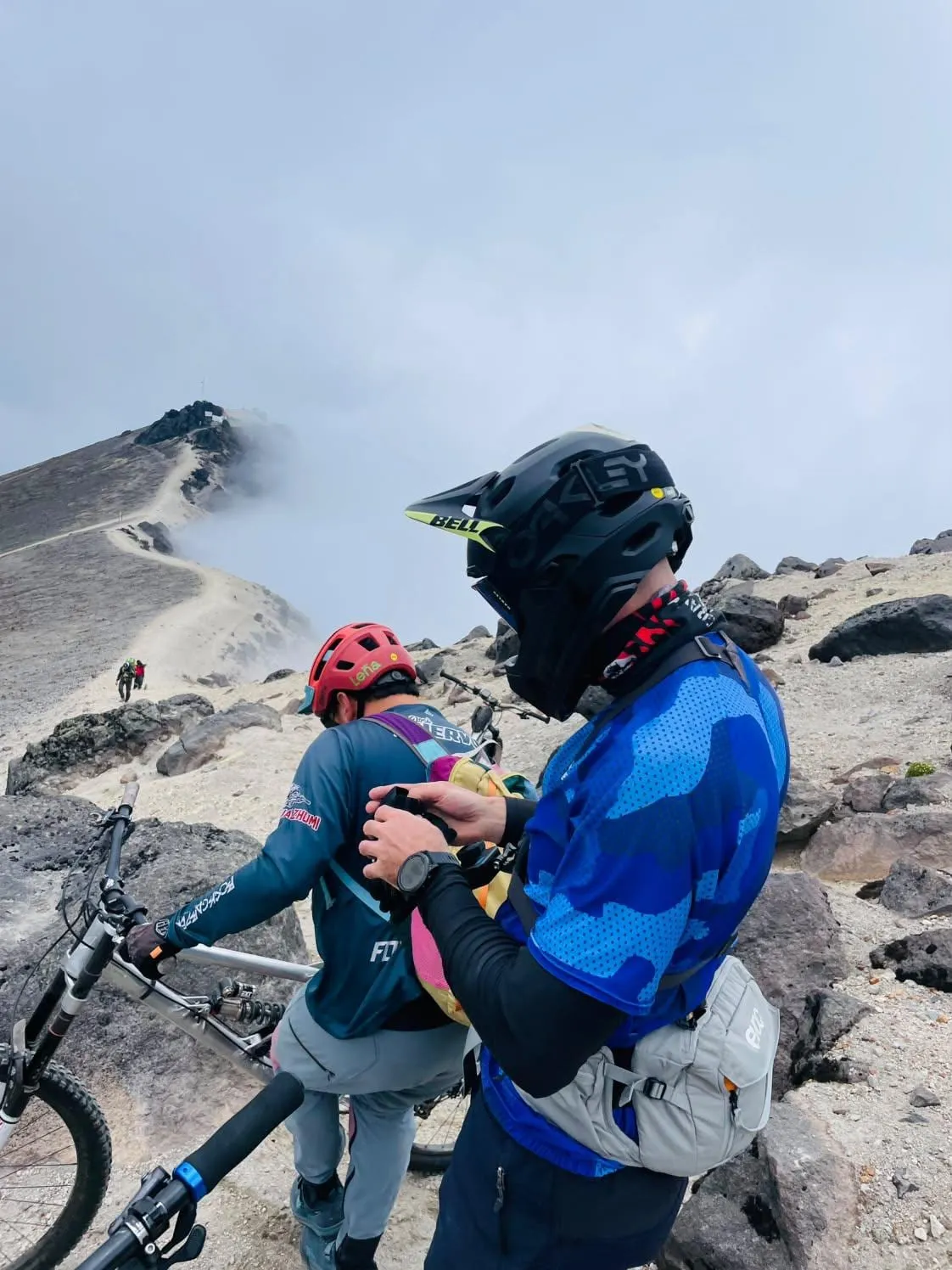
From 4,700 meters we descended all the way to Quito. First it was sand, then a jungle traverse made for Ecuadorians, because I barely fit through it, cutting through paths hacked into the tall grass. Then we passed the TelefériQo where I had been the day before, and dropped through the slums into the city, all the way to the center.
A friend of Cuervo’s came along, since it’s safer to ride through the slums in a bigger group. There were no problems in our case. You just ride down stairs, like a Red Bull urban downhill above Quito.
Cotopaxi
Cotopaxi, a glacier-capped volcano almost 5,900 meters high. We stayed in a small guesthouse with a view of the volcano and went riding in the national park. Cuervo is well known there for his mountain bike trips, and Maria, our co-driver, works at the park and took care of all the paperwork.
We drove up to about 4,700 meters. Close by is the refugio, the starting point for climbers heading to the summit. When we arrived, the volcano was completely hidden, but slowly the clouds began to open. It was truly spectacular.
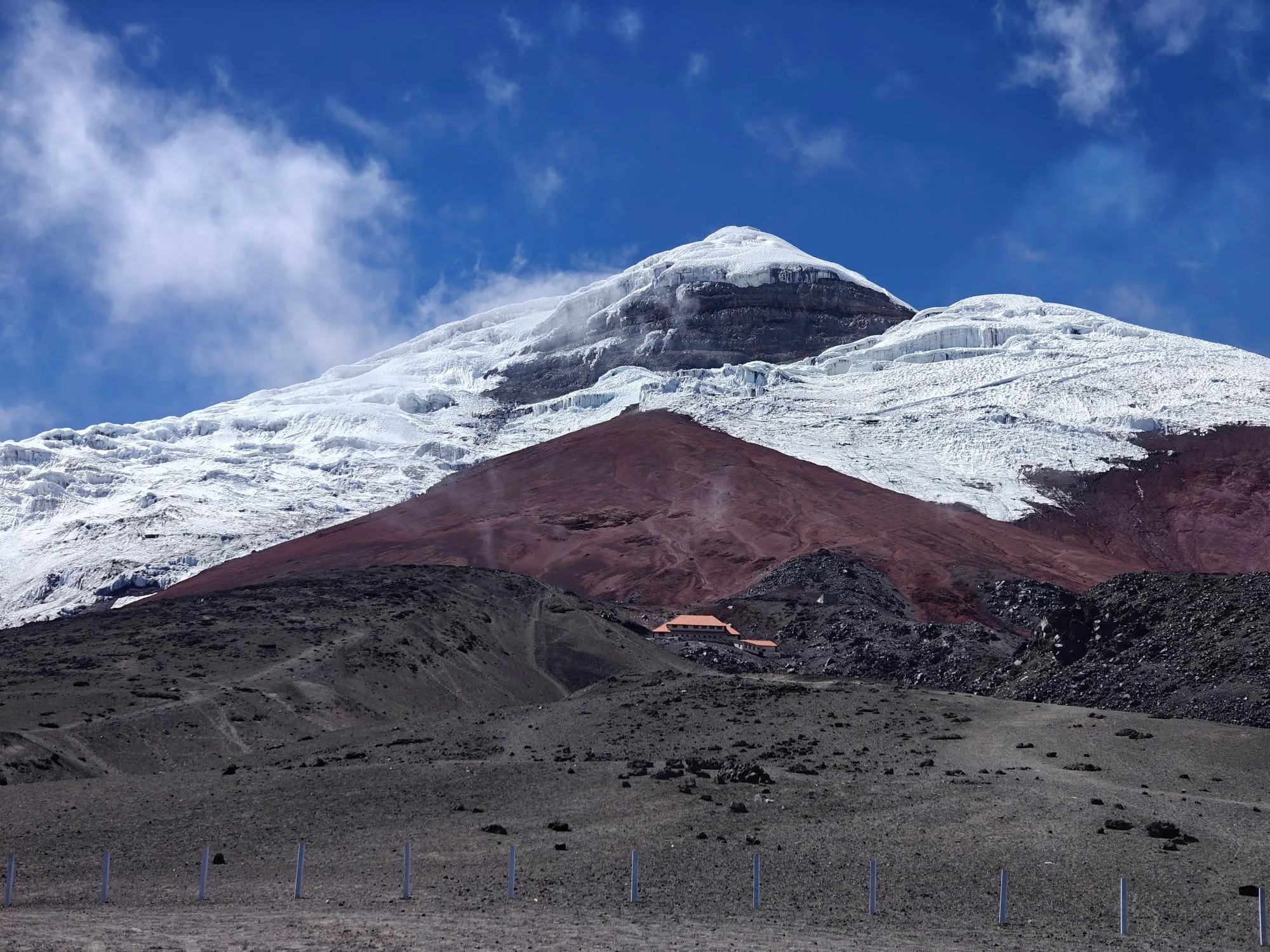
Cotopaxi
My first run was quite timid. I did not know how the sand would behave, and you basically cannot brake. It is so steep that once you let go, you are going. So I was just getting to know the track, which ends through a beautiful narrow canyon down to the main road. Perfect. We did the same route again and it went much better. There is also a section called Heaven’s Ridge, where we saw wild horses. On the last run we freerode all the way down, full gas. Except the weather changed. Fast. It started pouring brutally, hail was falling on our heads, and we could see lightning somewhere in the clouds. The only thing you can do at that point is keep working your way down. We arrived at the car completely soaked.
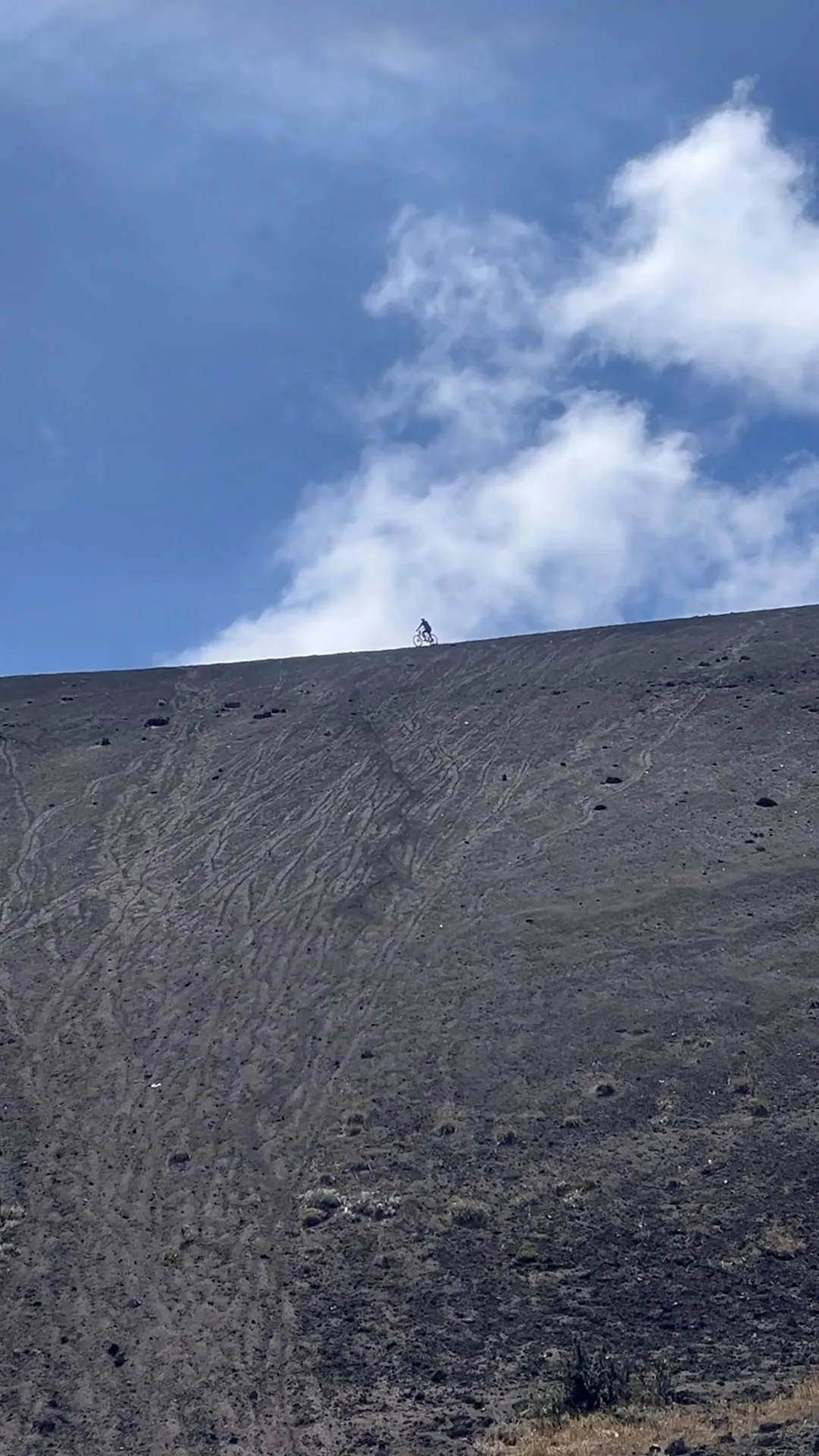
What a sandy wall !
Chimborazo, 2,000 meters of descent
Then we moved on to Chimborazo, a 6,200-meter volcano. You also drive up through a national park, and depending on the weather there are two options for what to ride. We chose a shorter downhill followed by an enduro trail.
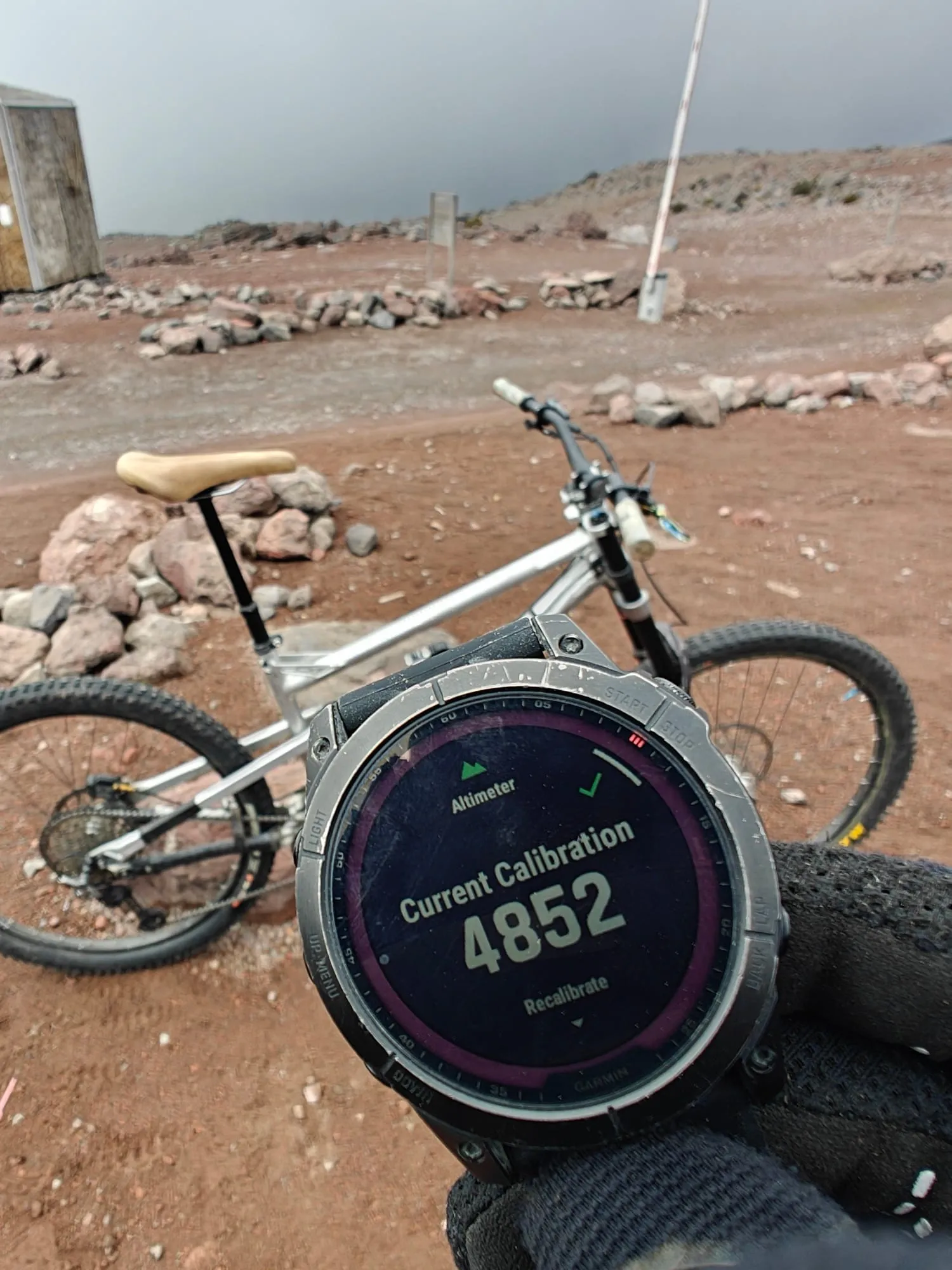
Start of the day
The section starts at 4,800 meters, flying down over sand. It is demanding, because the bike does not hold much. The only way to make it hold its line is to go faster.
Then came an enduro transfer down to the village. And when I say down to the village, I mean from 4,800 to 2,800 meters. 2,000 meters of descent. It was dramatic too, because clouds were coming up from the valley and you could barely see anything. But really, really nice.
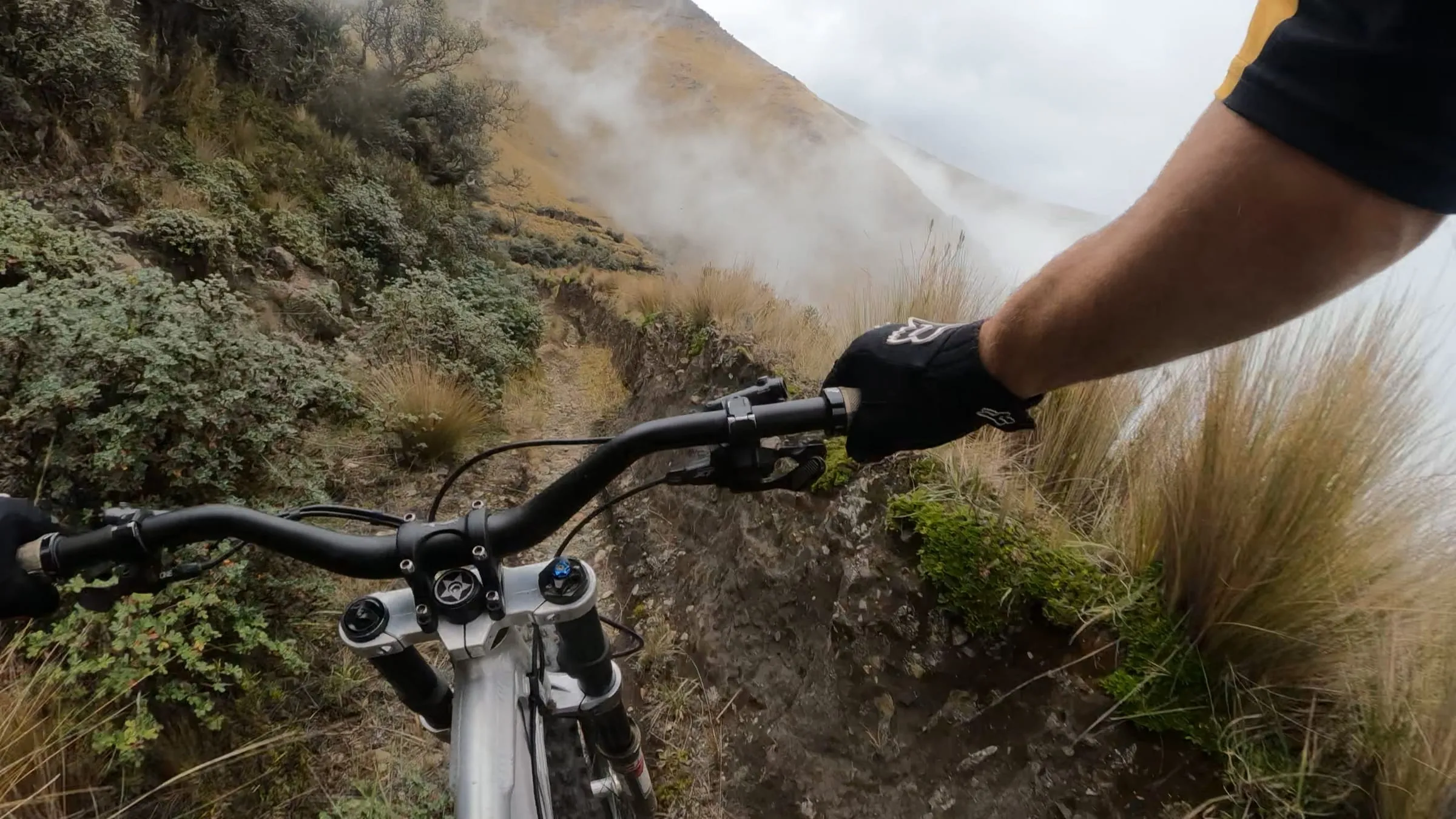
This time of year the weather is unstable, but there is a pattern. Almost every day it was nice until lunch, then the clouds rolled in and it poured. Real bombs.
Snow on Chimborazo
The next day we returned to Chimborazo, and this time it had snowed. The summit of Chimborazo is snow-covered, just like Cotopaxi, but I did not expect snow at “our” altitude. For the locals Chimborazo is a male mountain – “he”. The whole time I was there, “he” was in the clouds.
We did three runs. On the second one the entire road up was white, maybe 2 to 3 centimeters of snow. Yes, it did snow in the meantime. Then, you go down these sandy slopes and think that if I swapped the sand for snow, I would ski this. And here we were on bikes.
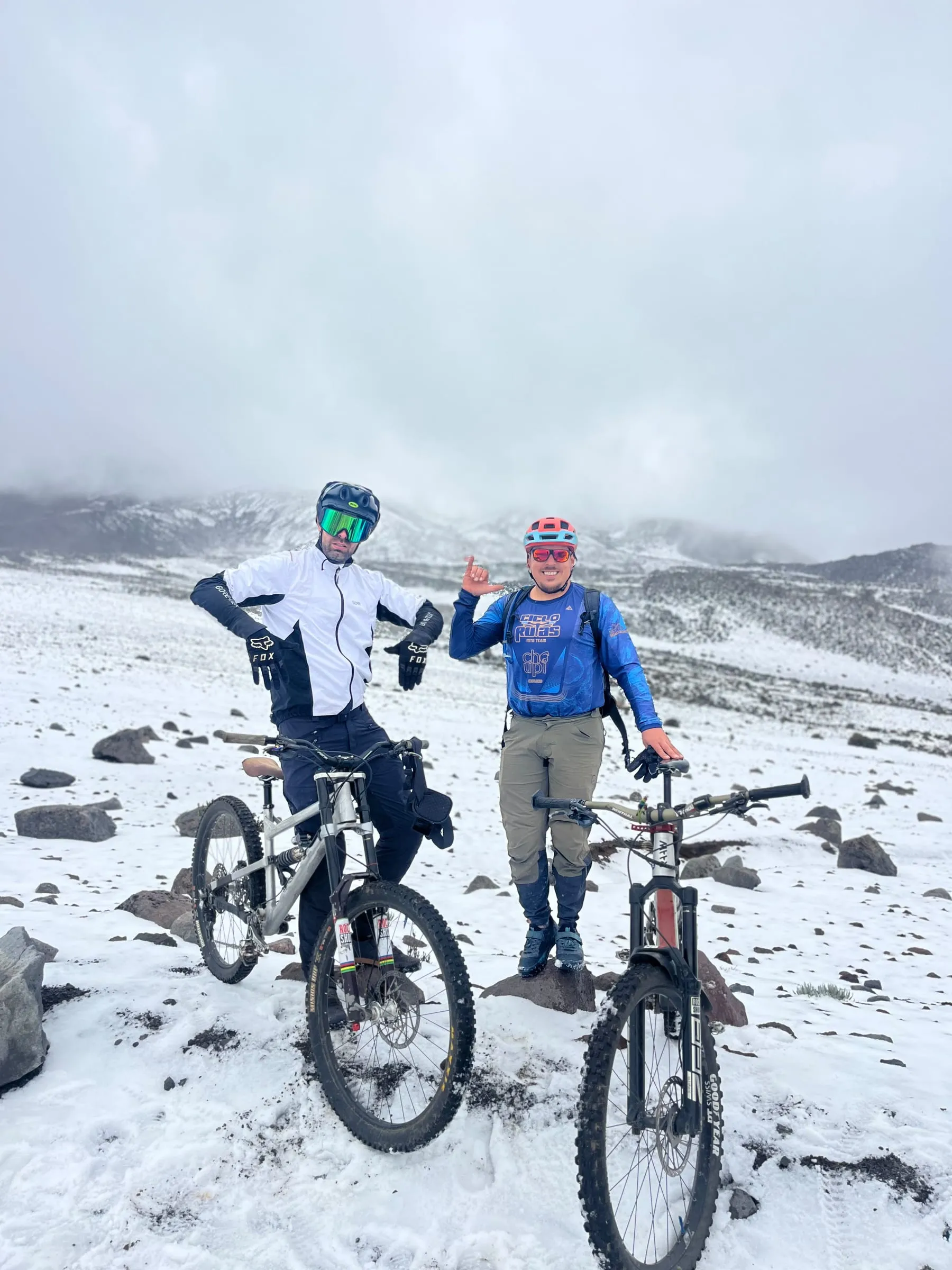
We also rode beautiful trails in the La Cacheria area, where the downhill races are typically held.
The dry forest
The fifth day was a transition. We moved north to Ibarra, where I met my second friend, Diego, and the three of us rode together.
This was something completely different again. It’s called a dry forest. It is all sand and completely dry, it hardly ever rains there, and everywhere you look there are agaves and giant cacti. I even crashed into one, luckily just barely touching it.
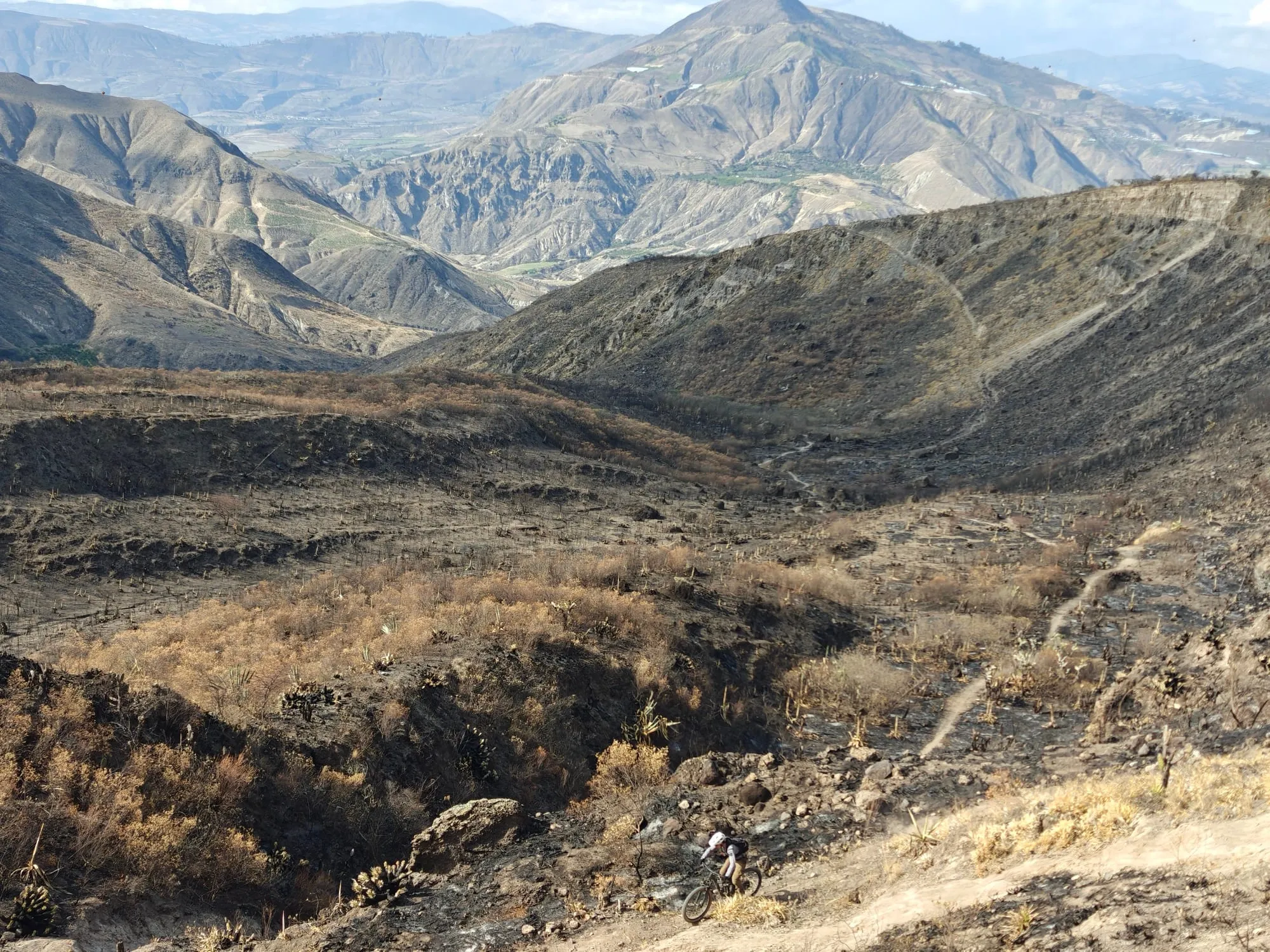
Dry forest
The trails are on a scale from hard to very hard. They are called Chota: Chota 1000, 2000, 3000, 5000. All sand, all dust, and you need skills for it, commitment and then just send it.
Diego wanted to show me a downhill track, but I could not ride it. It is so sharp and steep that you can’t even walk down. You try to use the bike as a brake, like poles, but that does not work either. You simply have to commit and go. They could ride it, of course.
Part 2: Three days on motorcycles
I stayed with Diego in Ibarra. He bought his parents’ house, is renovating it, and runs it as a bed & breakfast. Guests stay in the front house, and Diego lives in the back house with his mother and sister, where the kitchen is. His mother cooks, so we had breakfast and dinner there and I ate what Ecuadorians normally eat.
In Ecuador, everyone seems to borrow motorcycles and gear from friends. The pants I got were too small, so Diego’s father, who was helping with the house, jumped on a motorcycle, rode off to a friend’s place, and brought back a bigger pair. My boots came from a guy who won the Baja 1000, the famous off-road motorcycle desert race. Very funny.
Learning to float on sand
I expected to warm up a bit, but after 5 kilometers we went straight off-road. That means gravel roads, not too steep or dangerous, more like wider double tracks, but never asphalt. I spent the whole day getting used to the motorcycle, finding best position, how to stand, how to sit and how it floats in the sand. Sand wears you out because you constantly have to hold your balance.
It kept getting better, and there was one section I was especially proud of. A long, steep climb in sand with deep ruts, barely possible in first gear at high revs, with the rear wheel sliding around while you try to get up somehow.
We rode all around Ibarra, where Diego lives, for example from 2,000 up to 3,800 meters and then along gravel roads around the mountains all the way to his home. What a beautiful day.
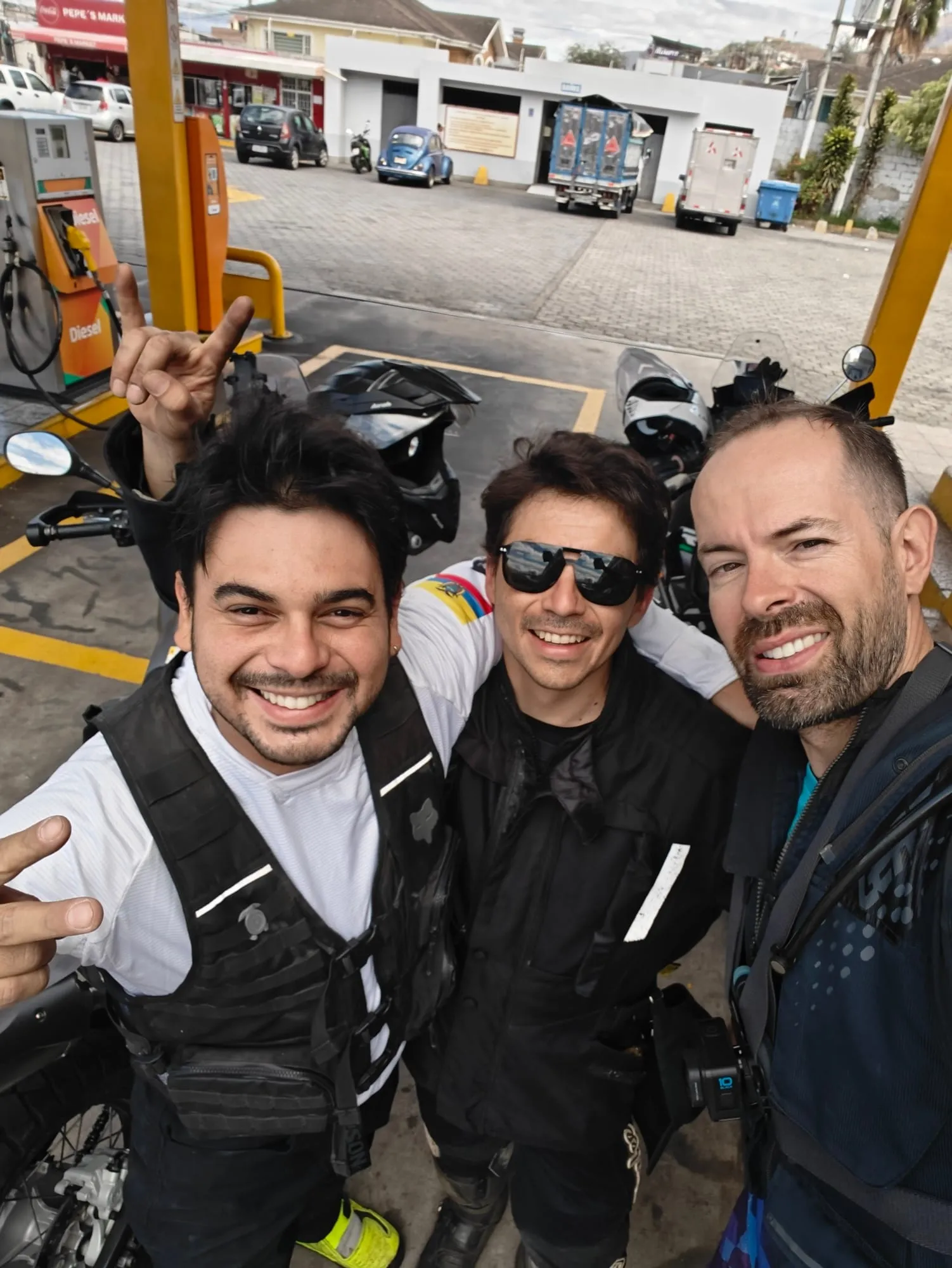
Getting the wisdom from Diego and Karlito
The evening was reserved for easy sightseeing. We sat in the car the whole time, neither of us felt like getting out. I took one photo, and that was it.
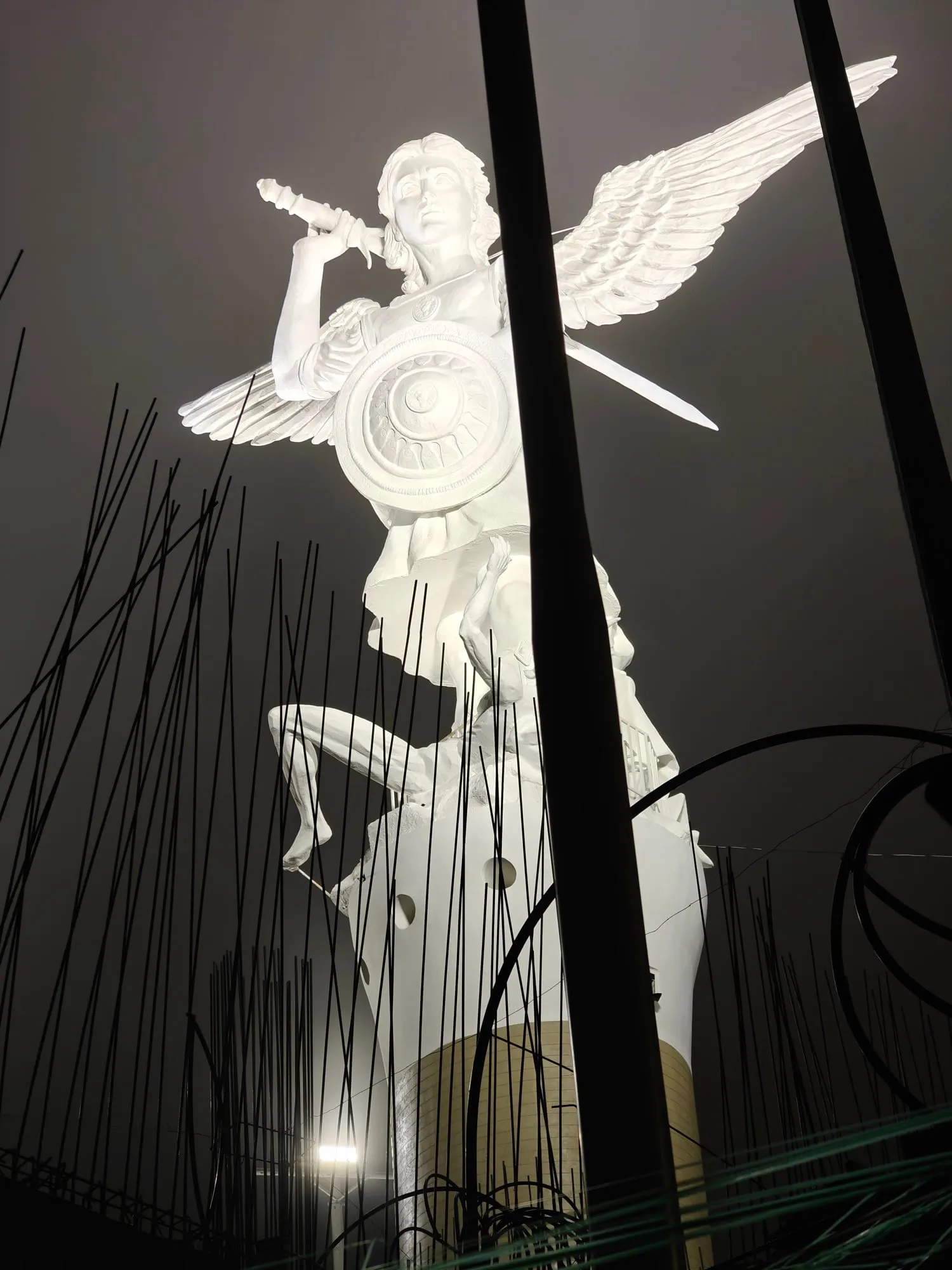
Ibarra angel
Night riding
My motorcycle was a 350cc, lighter and very forgiving. You can basically give it full gas and it is still OK.
Two of Diego’s friends joined us on dirt bikes. Both are experts and have won races. Diego has raced as well and was Ecuadorian enduro champion at some point. Absolute animals.
By lunch, I was truly proud of myself. I had started to add throttle coming out of corners, going out in a controlled slide, and I was really starting to enjoy it. It is still very hard, the bike floats around in the sand and throws you around.
After lunch the two guys left to ride something more challenging, and we continued the tour around one of the volcanoes. The sun started to set, so we turned on the lights and kept riding in the dark.
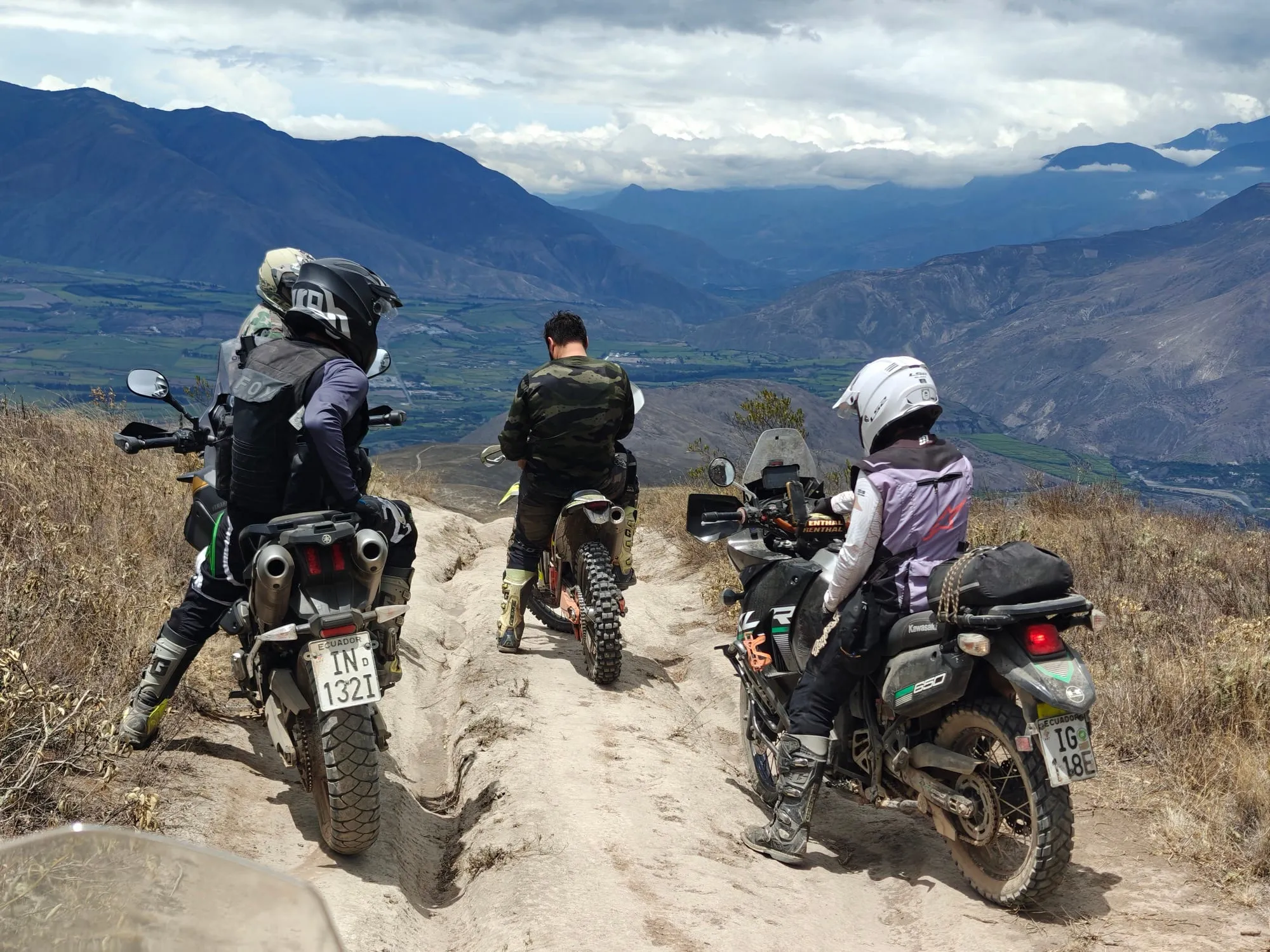
Years of hard enduro racing experience on this picture
They have held night races there for years, all organized by Diego’s father. Motorbikes have extra lights that shine brutally bright. At 30, 40 or 60 km/h, everything in front of you is lit up.
In the evening we ended up at a coffee finca, completely by accident. A friend of Diego’s knew the people there, and we got invited. I met the guy who runs the farm, and coffee is clearly his passion. He was quiet at first, but coffee is a bit of my thing too, so we got talking, and I even bought some beans. A really nice ending to the day.
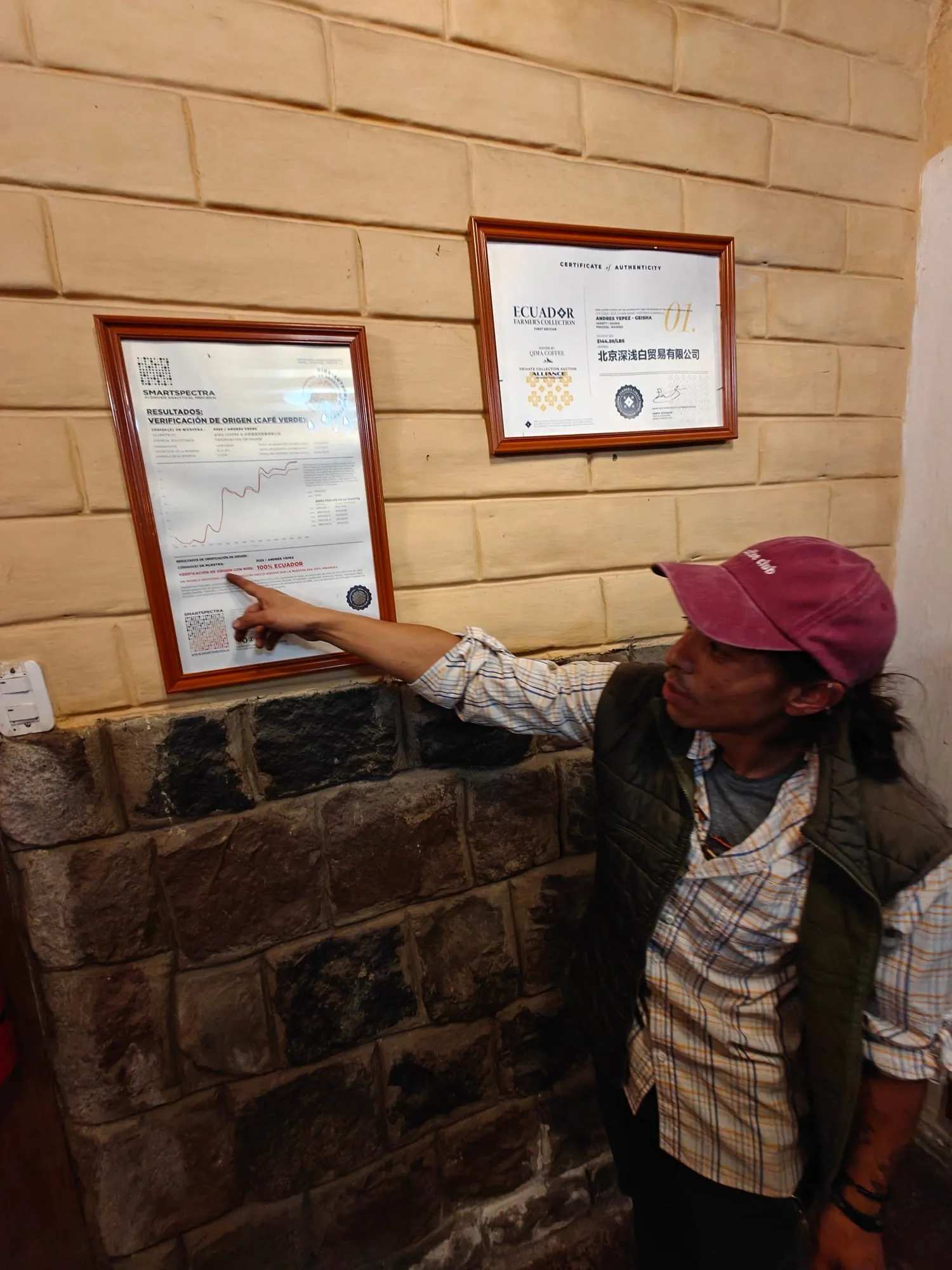
Best cafe in Ecuador ?
Hard enduro
Enduro means a very light dirt bike on very steep forest slopes and narrow paths.
First we stopped at Diego’s father’s to pick up a two-stroke Husqvarna. I had never ridden a two-stroke, and it is different. You constantly have to give it a little throttle or it dies. So I switched to Diego’s four-stroke race bike, which, on the other hand, has no electric starter. It stalled on me a few times and I had to kick-start it, which is a heavy workout too.
These enduro bikes are beasts. You can go over any rocks, and the suspension just takes it all. I learned how to work the throttle, but on those narrow paths it is really demanding.
And then you get descents where you think, how on earth am I supposed to get down this? This is for a mountain bike, not a 150 kg motorcycle! So I went down in first gear with the engine off, or on the brakes, or somehow.
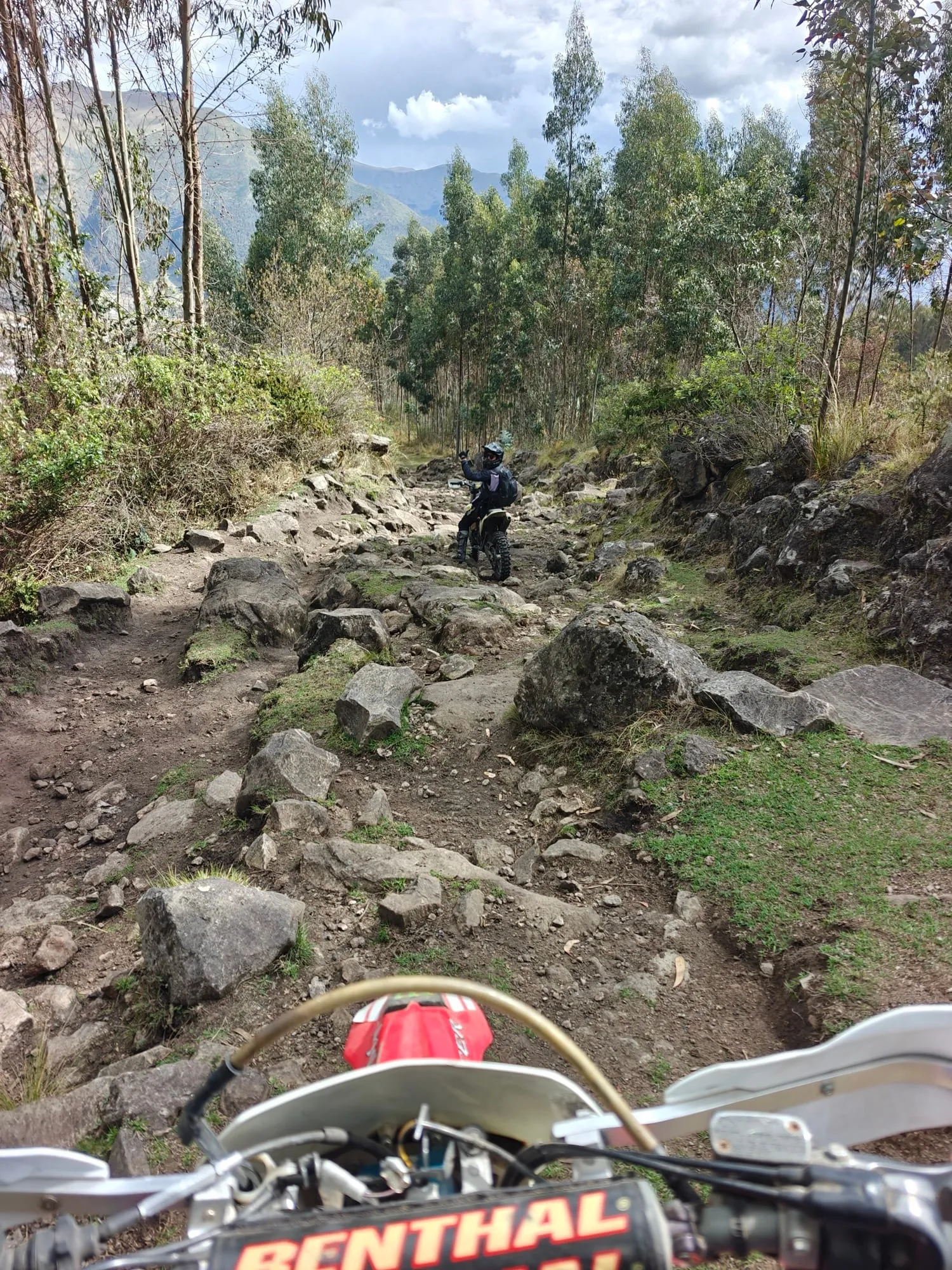
Diego says it’s all OK.
Part 3: The Galapagos
Diego drove me two hours to the airport in the early morning, and the third part of the trip began. The flight goes from Quito through Guayaquil to Baltra (Santa Cruz), and the return flight is direct.
Everything is expensive on the Galapagos, and you need dollars in cash everywhere. 200 USD for the national park entrance right after landing, then 5 USD for a bus, 1 USD for a water taxi across the channel to the main island, and another 5 USD for a bus to town. It is crazy, so make sure you have the dollars with you.
I spent the first day booking my excursions. Trips run either in the morning or in the afternoon, from 7 until 1 or from 1 until 6, like two shifts. Boats between the islands work the same way. You spend a lot of time just moving around, and if a boat does not go, you wait until the next day, which might be too late.
Isabela
The next morning I took the boat to Isabela. I arrived late for that boat, and the only seat left was at the very front, where it throws you around terribly. Two hours at sea, and I very nearly threw up.
Isabela feels far removed from the rest of the world, and no wonder. Tourism arrived here much later than on the other islands, and it has really picked up only in recent years. Before that it was just a fishing settlement. Now it is a tiny little town, without even proper roads, and they have only had internet for about three years, thanks to Starlink. It feels like going 100 years back in time.
I arrived at 10:30, and in the afternoon I went snorkeling, for the first time in my life, in the open sea. The boat stops somewhere and you have an hour in the water. I put on my wetsuit, first the wrong way around with the zip in front, then properly, added a life jacket on top, and off I went.
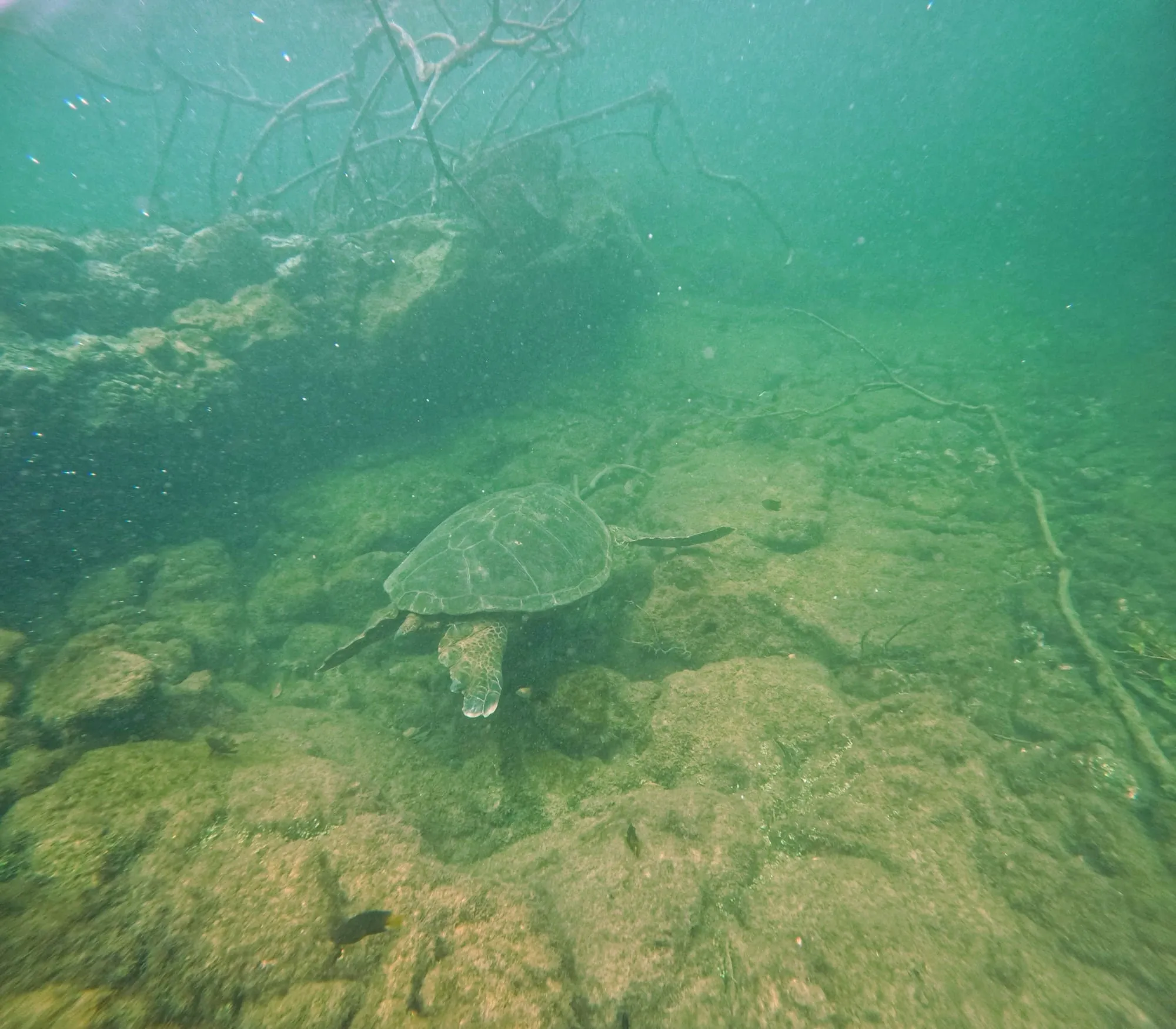
I saw huge sea turtles, seahorses and octopus which already blew my mind, and lots of different fish. People who could dive down also saw sharks and mantas.
And also been lucky to see penguins.
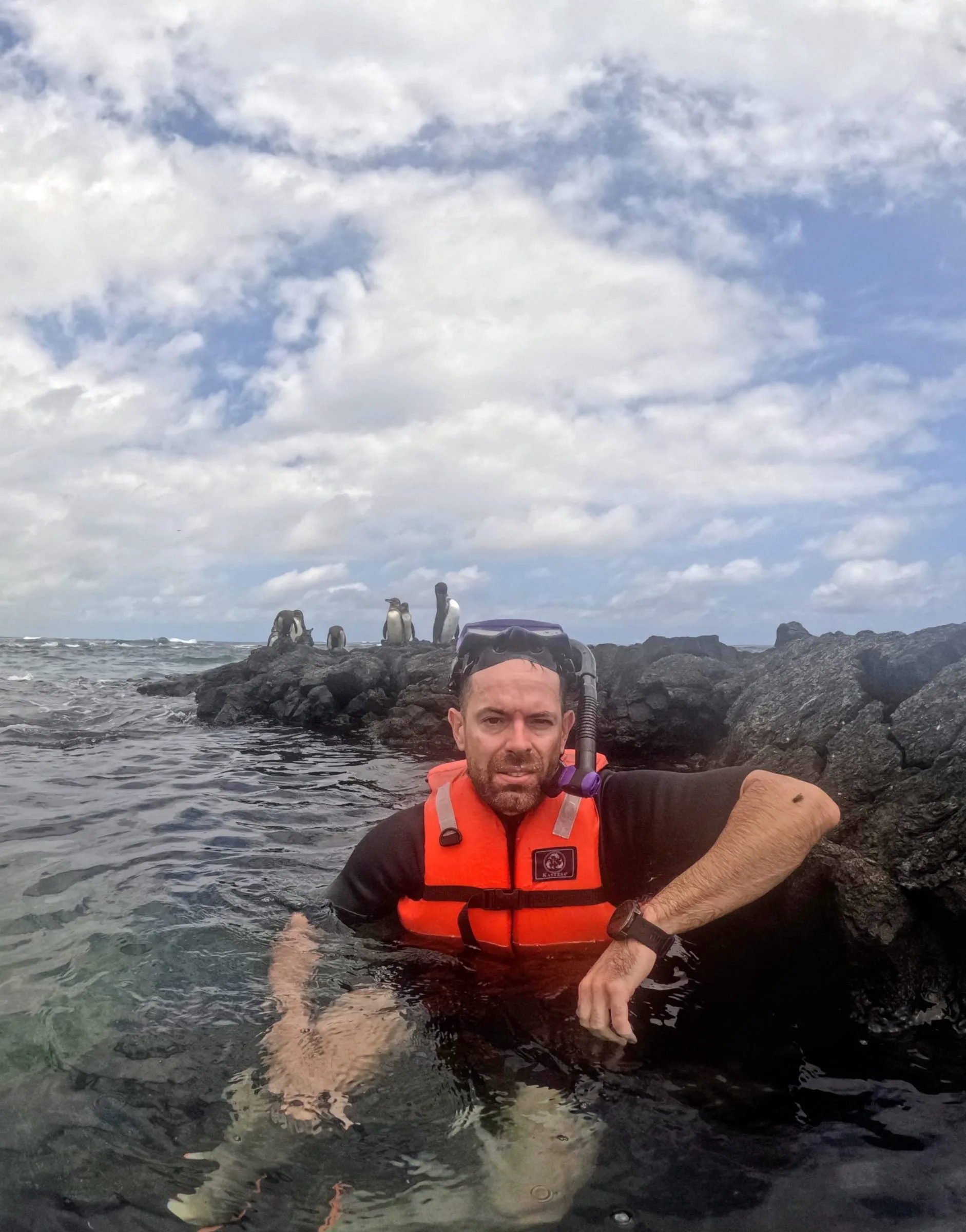
It was probably a tour for beginners, but for me it was absolutely enough. On the way back we stopped at another volcanic island to see a very special bird, the blue-footed booby.
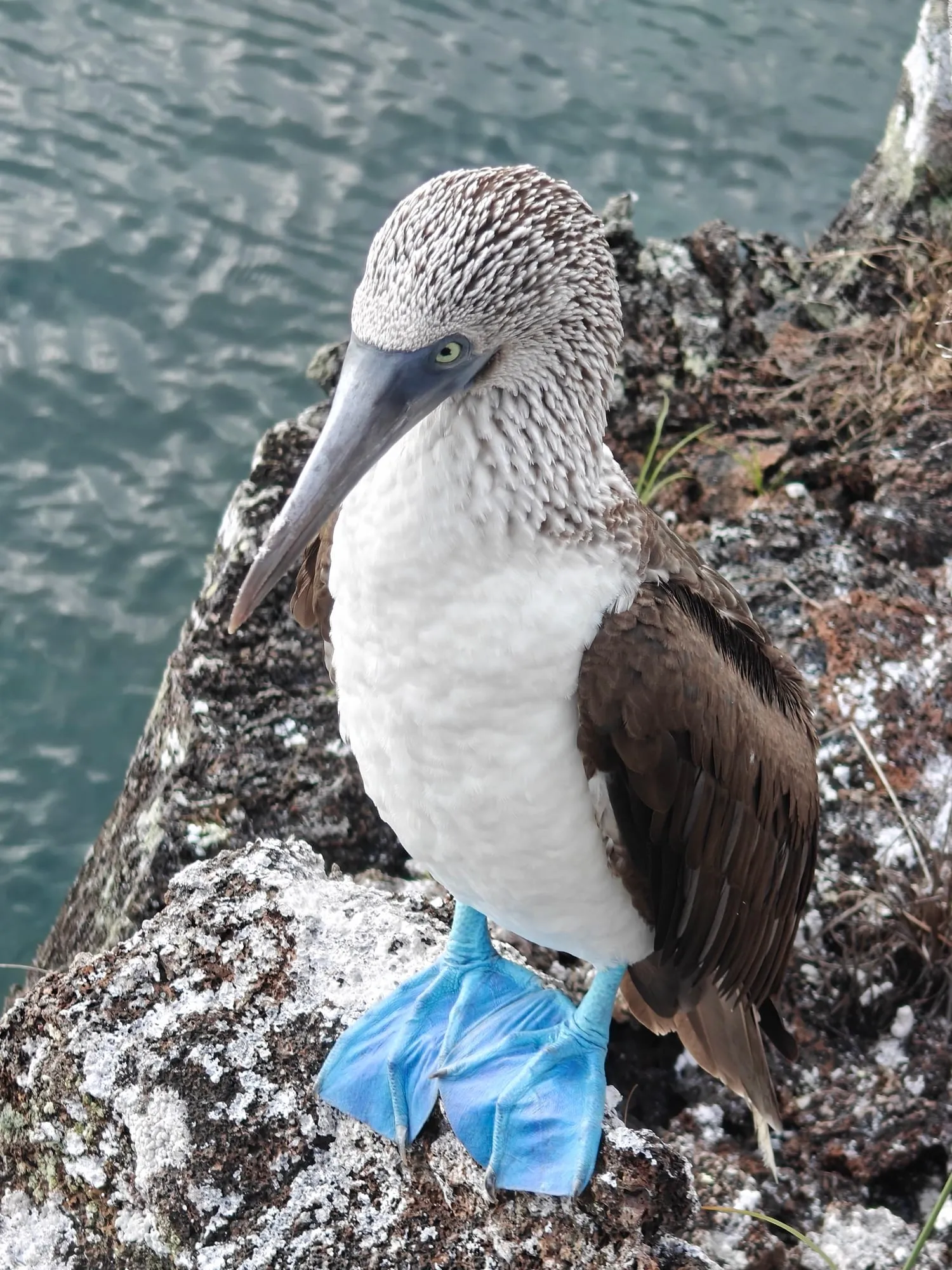
Blue-footed booby
Lava, a Wall of Tears and turtles in the road
The next day I went on a hike to the volcano. There is a huge caldera, still active, and from there you continue into a moon-like landscape of stones in every color. You can see two types of lava there, aa and pāhoehoe, Hawaiian names that stuck worldwide.
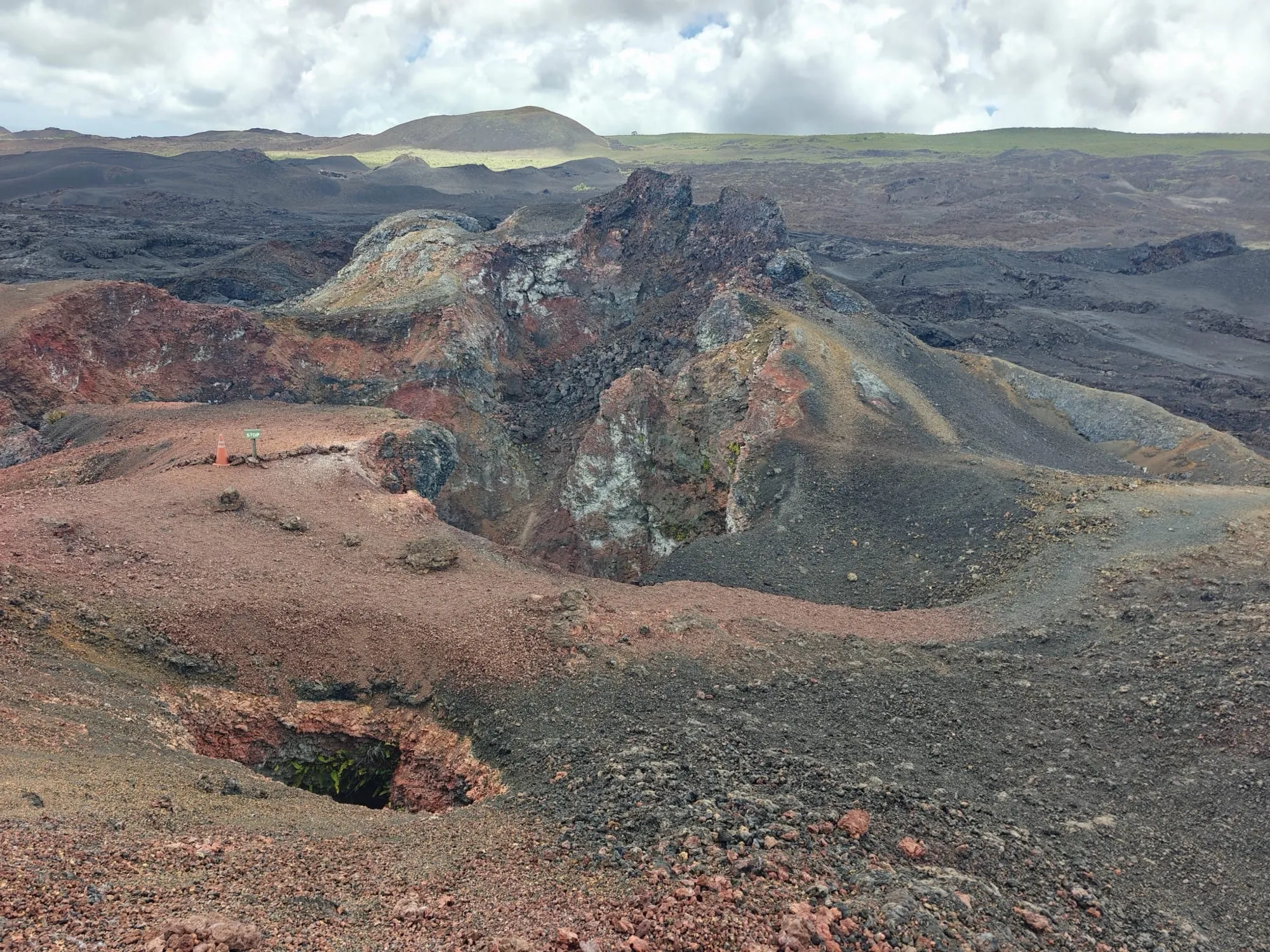
Moon-like scenery on the Galapagos
The hike left me half a day, so I rented a bike and rode to the Wall of Tears. The Galapagos used to be a penal colony. Prisoners had to haul lava stones and build a wall with no purpose at all, stacking stones for nothing. That is why it is called the Wall of Tears.
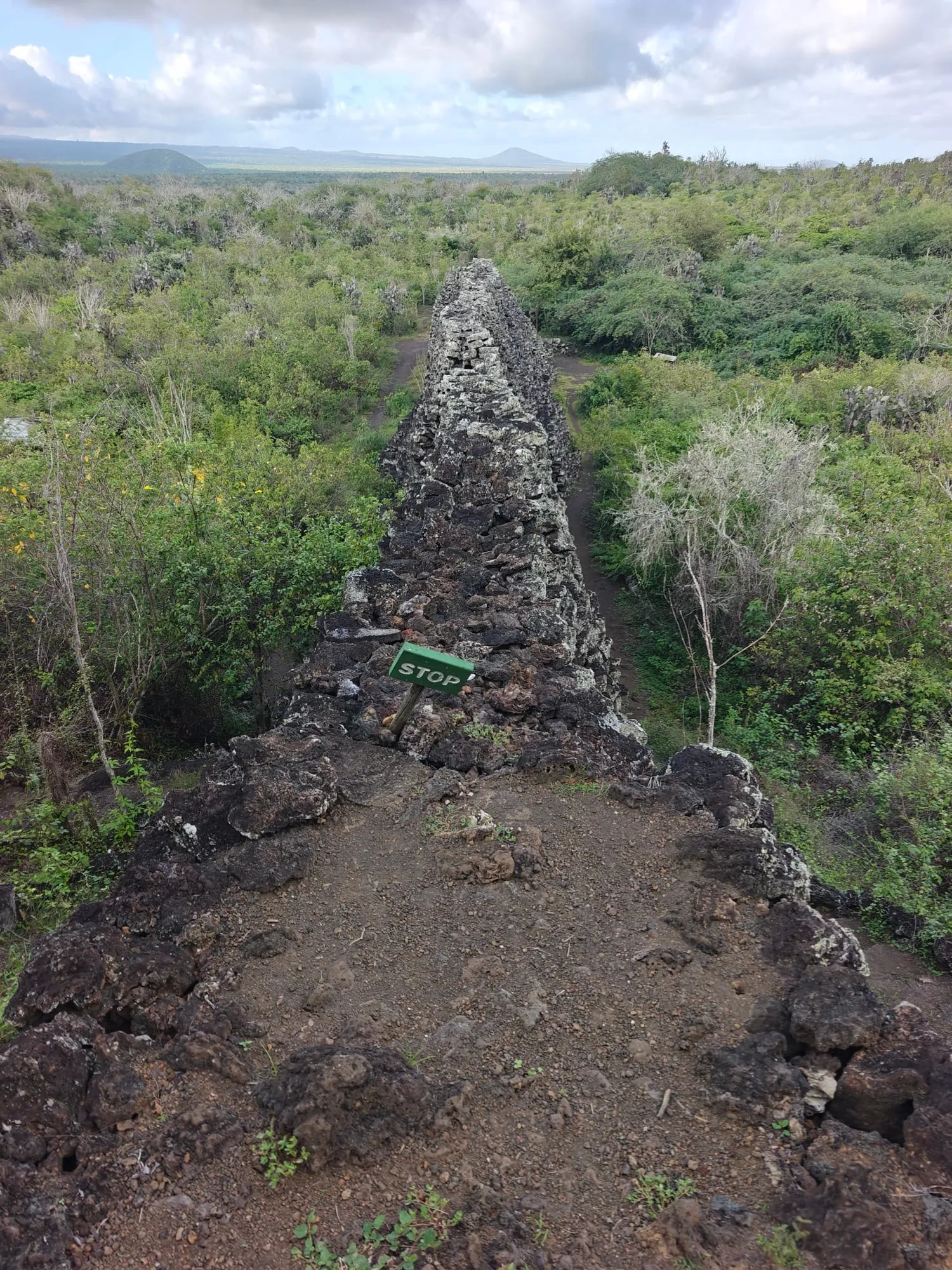
Wall of Tears
There also used to be an American radar station further on. From that spot you can see the whole of Isabela and how wild it is. Trees everywhere and nobody living there, and they want to keep it that way.
The road to the Wall of Tears runs through areas where they breed giant tortoises, so on the bike you keep meeting giant tortoises right in front of you, in the middle of the road or on the side. They are a bit afraid of you and pull into their shells. There are also sea lions just lying around and iguanas baking in the sun.
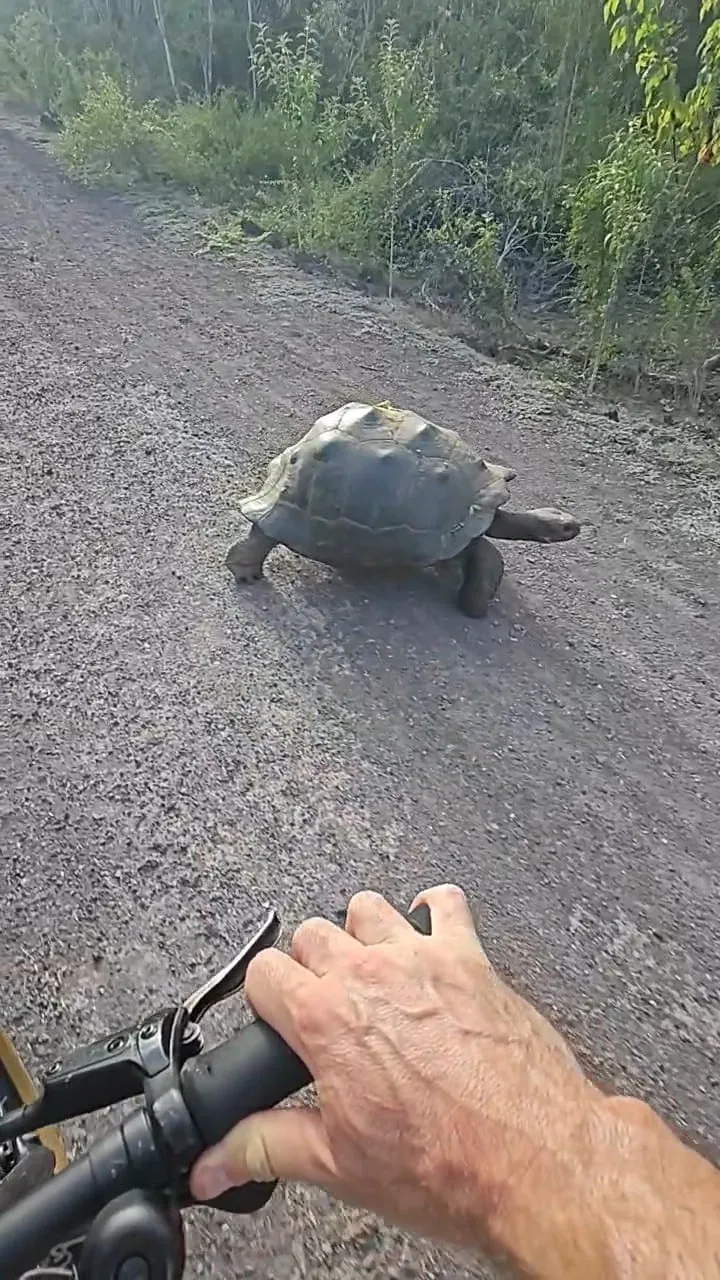
Concha de Perla
On my third day on Isabela I went snorkeling by myself, because I had the boat back to Santa Cruz in the afternoon. There is a place called Concha de Perla where you can snorkel for free. I rented my gear, fins and a life jacket. It is basically safe, but I was still a bit stressed. There is a deeper hole in the middle with rocks around it.
I swam with iguanas. Sea lions were biting each other’s tails and spinning right in front of me. There were sea turtles, tons of fish and starfish too.
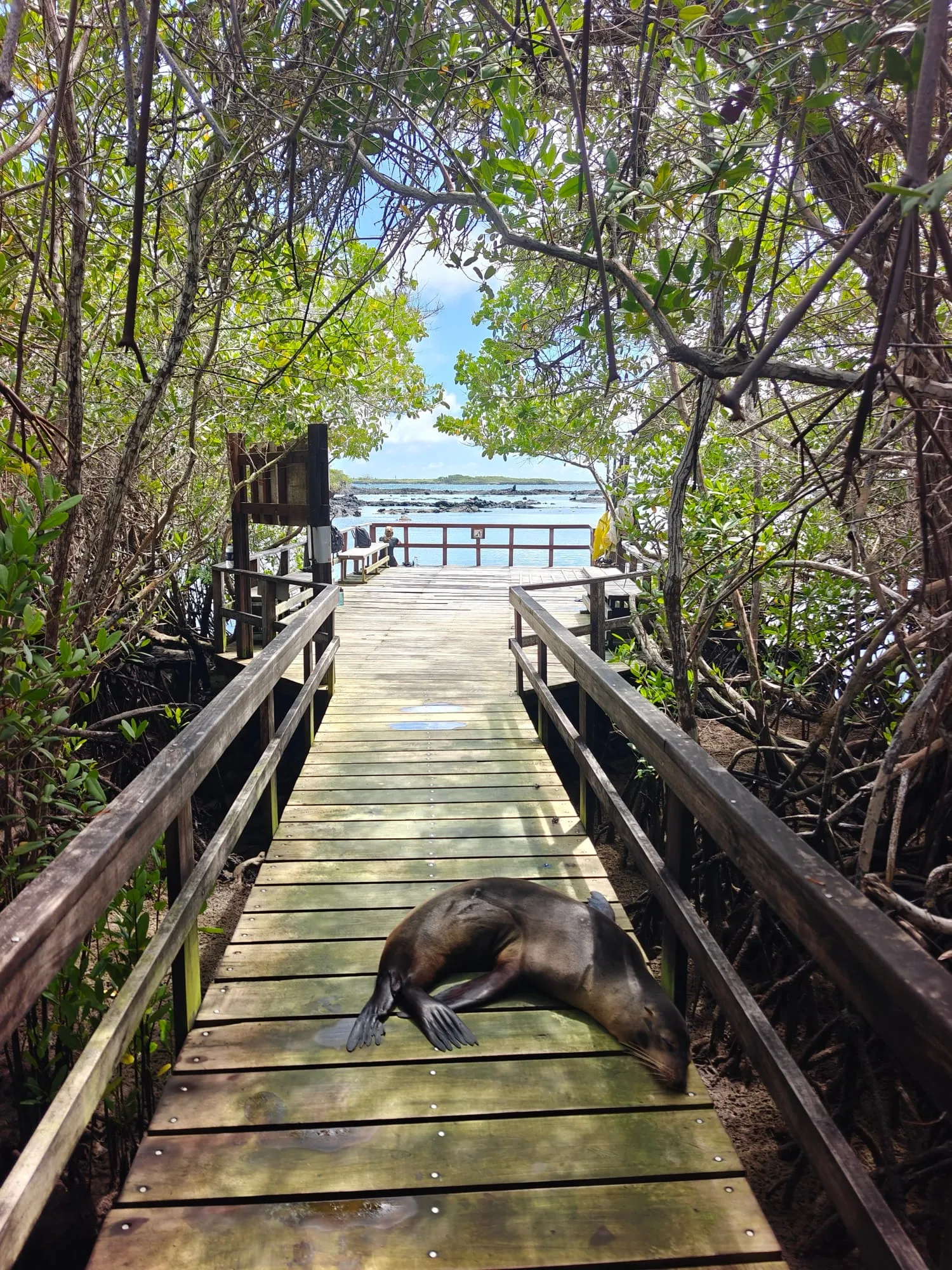
Entrance to Concha de Perla
What a trip
Three huge things I had never done in my life.
Snorkeling, and seeing those sea lions up close, was a perfect experience.
Off-road and enduro on the motorcycles was demanding and very beautiful. You go uphill at something like 10-15 km/h and downhill also at 10, slower than a mountain bike, so it might actually be fairly safe.
And the high mountains and volcanos, being at 4,800 meters on a bicycle, was something very special for me.
I also met some really cool people along the way. Cuervo (@josecuervojijon), Diego (@ranki.mtb) and their friends are all amazing folks to hang out with.
Sleep at altitude at home first. Pickup or delivery in Lugano and Zurich.